
ABOUT US
Connecting Faith, Building Community
"Set us free, O God, from every bond of prejudice and fear...that we may show forth in our lives the reconciling love and true freedom of God..."
God acts on the behalf of the oppressed...
The Union of Black Episcopalians stands in the continuing tradition of more than 200 years of Black leadership in the Episcopal Church.

absalom jones
1746 - 1818
Beginning with the establishment of St. Thomas Episcopal Church by Absalom Jones in 1794 in the city of Philadelphia through the election of Barbara Harris as Suffragan bishop of Massachusetts there has always been a strong corps of Black Christians in the Episcopal Church. People like James Holly, Henry Delaney, John Walker, Tollie Caution, Charles Lawrence, Deborah Harmon Hines, and countless other.
Organized in 1968 as the Union of Black Clergy and Laity, the Union is the proud inheritor of the work of these people and earlier organization, the Convocation of Colored Clergy, the Conference of Church Workers Among Colored People, all dedicated to the ministry of Blacks in the Episcopal Church. The name was changed to the Union of Black Episcopalians in 1971.
The Union of Black Episcopalians is a confederation of more than 55 chapters and interest groups throughout the continental United States and the Caribbean. The Union also has members in Canada, Africa and Latin America.

barbara harris bishop
Different names, but the same agenda: Precursors to the Union of Black Episcopalians.
By The Reverend J. Carlton Hayden, Ph.D

bravid harris
1896 - 1965
The earliest known national organization among Black Episcopalians is the PROTESTANT EPISCOPAL SOCIETY FOR PROMOTING THE EXTENSION OF THE CHURCH AMONG COLORED PEOPLE, founded in 1856 by James Theodore Holly of St. Luke’s, New Haven. There were then four Black clergy and seven congregations. With their female auxiliary, the GOOD ANGELS, they fought the exclusion of Blacks from Episcopal seminaries and diocesan conventions, as well as the refusal of the Episcopal Church to take a stand against slavery. The SOCIETY, like all Black America, was divided over the issues of emigration to Africa or Canada for immediate freedom, or remaining in the States for eventual freedom. In 1861, Holly immigrated to Haiti. A remnant carried on for a few years under Samual V. Berry of St. Phillip’s Church, Buffalo, New York.
After the Civil War, General Convention’s PROTESTANT EPISCOPAL FREEDOM’S COMMISSION established schools and churches in the South. Southern white resistance, northern white apathy, and dwindling revenues led to the disbanding of the Commission in 1867. That same year, a group of Blacks in Baltimore founded the SOCIETY FOR THE PROMOTION OF CHURCH WORK AMONG THE COLORED PEOPLE. It pressed for the reestablishment of a national program for black evangelism and education. In a few years it ceased to meet.
In 1882, a Mississippi priest launched a virulent attack on blacks, arguing that sparse black Episcopal growth was due to their intellectual, moral and leadership inferiority. The southern bishops then proposed the Sewanee plan to segregate blacks into a racial diocese. John Peterson, an aged teacher and deacon at St. Philip’s Church, New York, called the black clergy together, who organized the CONVOCATION OF THE COLORED CLERGY, with the distinguished Cambridge scholar and missionary, Alexander Crummell of St. Luke’s, Washington, D.C., as the first president. Later the name was changed to the CONFERENCE OF CHURCH WORKERS AMONG COLORED PEOPLE since some black laity and two white priests had joined.
The CONFERENCE met annually. Every third year, it met at the site of General Convention and appointed lobbyists to press for black goals. Conferences were highly organized, with grand festive services, lectures, reports and stirring debates. Annual proceedings were published. It sponsored a monthly newspaper, The Afro-American Churchman, and later, The Church Advocate, edited by George Freeman Bragg, Jr., of St. James, Baltimore. The interaction on a national basis fostered a common distinctive churchmanship among black Episcopalians.
The CONFERENCE, through protest and agitation, served as the conscience of the Church, recalling it to its catholic ideal. Over the years, the CONFERENCE partially achieved many goals. Segregation was never written into national policy or canon law. Another national commission to evangelize and educate southern blacks was established. A black priest was appointed to the commission. Academic standards for black candidates were not lowered. A black priest was added to the staff of Bishop Payne Divinity School, the South’s seminary for blacks. A theological college for blacks, King Hall, was established at Howard University. After several unsuccessful appointments, a black priest, William Victor Tunnell, professor of history at Howard, was named Warden. Industrial education never became the sole focus of Episcopal schools in the South, and Saint Augustine’s College was eventually developed into a four-year, degree granting college. In 1937, a black priest, Bravid Harris, became Secretary for Negro Work. He was succeeded by Tollie L. Caution.
The CONFERENCE continued until the mid-1960’s, although it gradually gave way to the EPISCOPAL SOCIETY FOR CULTURAL AND RACIAL UNITY (ESCRU) founded in 1957. Although ESCRU seemed more in tune with the political thrusts of the Civil Rights Movements, it was unable to adapt to Black Power and ceased to function.
On February 8, 1968, seventeen Black priests met at St. Philip’s Church, New York, and founded the UNION OF BLACK CLERGY AND LAITY (UBCL) to remove racism from the Church and society and to stimulate the growth of black membership. The name had changed, but the agenda remained the same.
UBE History Moment:
Rev. Dr. J. Carleton Hayden (1933-2022)
"Historian, Priest, and Builder of Black Episcopal Memory"
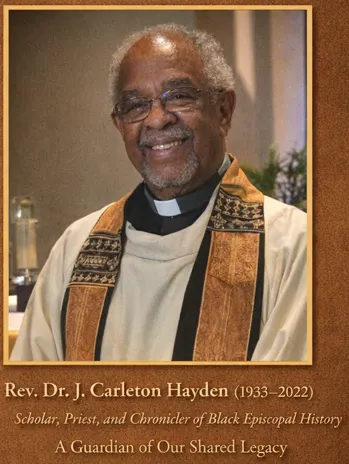
UBE History Moment:
Rev. Dr. J. Carleton Hayden (1933-2022)
"Historian, Priest, and Builder of Black Episcopal Memory"
In the decades following the founding of the Union of Black Episcopalians, Rev. Dr. J. Carleton Hayden emerged as one of the Church’s most prolific chroniclers of Black Episcopal history. A priest, professor, and institutional leader, Hayden’s work helped preserve the stories, struggles, and triumphs of Black Episcopalians across generations.
Ordained in 1964 and earning his Ph.D. in African American History from Howard University in 1968, Hayden brought scholarly rigor and pastoral care to every role he held, from parish ministry in Washington, D.C. to his tenure as chaplain at Howard and associate dean at Sewanee’s School of Theology.
His contributions to UBE and the wider Church included:
- Historian and Educator-documenting the lives and ministries of Black Episcopal leaders, shaping curricula, and mentoring seminarians across institutions.
- Advocate for Equity, serving on the boards of UBE, the National Council of Churches, and diocesan committees focused on justice and inclusion.
- Builder of Institutional Memory, preserving the legacy of Black Episcopal witness through archives, oral histories, and curriculum development.
UBE History Moment:
Rev. Tollie LeRoy Caution (1902-1987)
"Steady Hands at the Birth of a Movement"
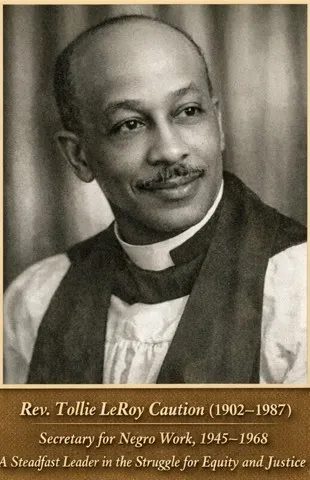
UBE History Moment:
Rev. Tollie LeRoy Caution (1902-1987)
"Steady Hands at the Birth of a Movement"
In July 1968, as Black clergy and lay leaders gathered at St. Augustine’s College in Raleigh, Rev. Tollie L. Caution stood as one of the most trusted and experienced voices in the room.
After more than two decades as Secretary for Negro Work, he carried deep institutional knowledge and a steadying presence into a moment of profound transition.
His leadership during the founding of the Union of Black Clergy and Laity (later UBE) reflected three essential contributions:
- Advisor and Elder Statesman, grounding the gathering in the long struggle for recognition, equity, and dignity within the Episcopal Church.
- Institutional Bridge-helping participants navigate national church structures so the new organization could speak prophetically while retaining strategic leverage.
- Mentor to Emerging Leaders-encouraging younger clergy and lay activists whose voices shaped the Liberation Eucharist and the early identity of UBE.
Rev. Caution’s influence was quiet but decisive. His presence linked the new movement to the generations who had labored before 1968, ensuring that UBE’s founding was not only an act of protest but also an act of continuity, faith, and disciplined leadership.
His legacy endures in UBE’s commitment to advocacy, formation, and the flourishing of Black Episcopalians across the church.
UBE History Moment:
The Rt. Rev. Barbara Clementine Harris (1930-2020)
Trailblazer, Preacher, and Advocate for Justice
Her Contribution to the 1968 UBE Founding Conference
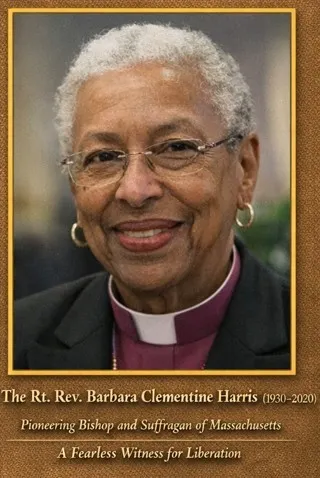
UBE History Moment:
The Rt. Rev. Barbara Clementine Harris (1930-2020)
Trailblazer, Preacher, and Advocate for Justice
Her Contribution to the 1968 UBE Founding Conference
In July 1968, at St. Augustine’s College in Raleigh, Barbara Harris joined the historic gathering as a lay leader and civil rights activist. Her contributions were vital:
- Voice of Early Lay Leadership-ensuring that the new UBE would uplift Black lay voices alongside clergy concerns.
- Bridge Between Civil Rights Activism and Church Reform-bringing the spirit of the Selma marches into the push for change in the Church.
- Champion for Women’s Inclusion, demanding recognition of Black women’s leadership long before ordination was possible.
Her presence helped fuse the urgency of civil rights with a vision for a more just and inclusive Episcopal Church.
Her witness continues to inspire UBE’s pursuit of equity, dignity, and the full flourishing of Black Episcopalians.
